Tuesday, 6 August 2013

Ivory Coast Chiefs: some images from the Smithsonian Elisofon Archives

eepa_01519

Baule dignitary N'Goran Koffi with his linguist and elders, Kouassiblekro, Ivory Coast, Baule dignitary N'Goran Koffi with his linguist and elders, Kouassiblekro, Ivory Coast, Eliot Elisofon Field photographs, 1942-1972 [slide].eepa_01519.jpg (1230×840)

eepa_01546

Kyaman chiefs and notables, Anna village, Ivory Coast, [slide]. Contained in: Eliot Elisofon Field photographs, 1942-1972 The photograph depicts Ebrie (now Kyaman) dignitaries wearing prestige clothes and regalias. .eepa_01546.jpg (1230×840)


eepa_02708

Dan men wearing hat called tarboosh, Man region, Ivory Coast.The photograph depicts three men wearing black and white robes of locally woven cloth. Their red hats, Tarboosh, are similar to those worn by other Moslems further north. This photograph was taken when Eliot Elisofon was on assignment for Westinghouse Film and traveled to Africa from October 26, 1970 to end of March 1971. eepa_02708.jpg (840×1230)

Click on the photos to enlarge. For many more please explore at the Smithsonian Eliot Elisofon Archives here.

Thursday, 1 August 2013

Cloth of the month: A unique wool cloth from Mali.

FR547

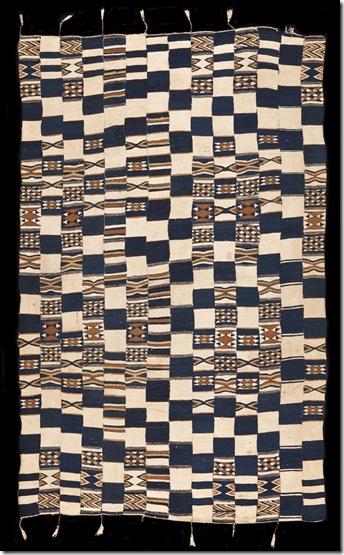
On my recent visit to Ghana I was pleased to find this remarkable wool and cotton cloth from Mali, collected by one of my contacts from the chief of a small village in the north west of the country.  Itinerant traders from Mali have been selling cloths in Ghana and neighbouring countries for at least 500 years so the presence of this cloth was not too surprising in itself. Wool blankets from Mali have become an accepted part of the court regalia of many Ghanaian chiefs, used for a variety of purposes including lining ceremonial hammocks and palanquins, covering royal drums, and just as a backdrop for displays of the royal treasures.

The surprising, and to my knowledge, unique aspect of this particular cloth is the design and layout. Made up of 14 strips of approximately 3 1/2 inch width (9cm), squares of indigo blue dyed wool alternate with squares of white handspun cotton, serving as a backdrop for quite complex patterning in natural brown dyed wool executed using a tapestry weaving technique, these strips would normally have been laid out in a much more regular fashion to form a far larger cloth, called an arkilla jenngo.
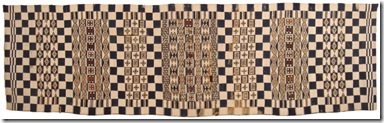
arkilla-jenngo-a2-complet-ref-2057-123x439

Arkilla jenngo were, according to Bernhard Gardi, woven in the area west of Tomboutou near Lake Faguibine by Songhay-speaking weavers, primarily working for Tuareg patrons. Interestingly he notes that according to his informants this type of wool blanket was not traded to Ghana. They were used as highly prestigious tent hangings for high status weddings.

Widmer

Photo above by Harald Widmer, January 1952. The names given to the motifs “reflect the significance that weddings and bride wealth have in social life: we have for example,  ‘cushion’,  ‘bedposts’, ‘money’, ‘board game’, ‘leather fringe’, or ‘calabash’. (Gardi 2009.)

FR547d

Turning back to our cloth we can now see that the standard strips woven for an arkilla jenngo have been put together in a different and unexpected way, with the regular layout of the traditional form replaced by an apparently random placement creating an “offbeat” staggered overlap and contrast between each strip and an overall dynamic oscillation across the cloth.  How can we tell that this was a deliberate effect and not just the random result of a partial or damaged arkilla being re-purposed by someone unfamiliar with the tradition ?

If we look at the ends of the cloth we see that it was carefully finished with a braided wool cord making up a series of tassels. This was the normal technique in Mali for finishing a smaller type of wool blanket known as a kaasa, and clearly shows that this cloth was assembled by someone working within that tradition. So we can only speculate on why this novel layout was adopted and it remains a mystery.

Tuesday, 30 July 2013

“Cloth in West African History” by Colleen Kriger

kriger

Last Monday Colleen and I met for a chat in a sunny London square and we had a kind of African textile show and tell. I showed her a few obscure early Nigerian textiles from my collection while she showed or rather told me of even earlier and more obscure fragments of information she had uncovered in her continuing archival investigations. My idea of a great time as you can imagine.

I was pleased to hear that Colleen is working on a new book but in the meantime this seems a good point to remind you of her important previous work Cloth in West African History which anyone interested in African textiles needs to own. Still available from Amazon  so buy one today.

krigerback

Wednesday, 17 July 2013

Exploring the West African textile collections of the Musee du Quai Branly: Part Four–Two Fon Royal Tunics.

benin2

“Gbecon-Huegbo workshop and Yemadje family: Ceremonial tunic (?), Fon style -  late 19th Century. Cotton 87.5 cm x 143. #71.1936.21.103 Musee du Quai Branly. Donated by Bernard Maupoil.”

“The kansawu is a “predator” tunic, designed to give freedom of movement to the arms and hands. However the presence of pockets means this is an item of clothing of the court, even a royal item. The quality and the extent of the embroidery, undoubtedly inspired by workshops in the Yoruba and Hausa territory, indicate its value and the rank of its wearer. This item of clothing was a joint work between the weavers of Gbekon Huegbo and Hounli, the cutting workshop and the Yemadje embroiderers of the Hountondji district.” [Abomey, Benin Republic.]

text by Joseph Adandé (Source:  Gaëlle Beaujean-Baltzer ed. Artistes D’Abomey – Fondation Zinsou, 2009).

benin1

“Gnimavo family  and Yemadje family: Prime Minister’s robe, Fon style -  between 1818 and 1858. Cotton and bone. 103.5 cm x 103.5cm x 10cm. #71.1936.21.66. Musee du Quai Branly. Donated by Bernard Maupoil.”

“Robe of Xagla, the migan of Guez0 (1818-1858). On the front a goats’ skull, from which the migan drank alcohol in private, before the sacrifices. Inside, a human jawbone, on which was eaten the powder of strength. the goats’ head has been daubed with human blood. (…) Robe worn when an enemy king or a particularly redoubtable individual was about to be exexcuted.” (Inv. Musee de l’Homme by B. Maupoil, 1936.) “

(Source:  Gaëlle Beaujean-Baltzer ed. Artistes D’Abomey – Fondation Zinsou, 2009). I would urge anyone to track down this remarkable and beautifully designed catalogue/book.

Friday, 12 July 2013

“Majestic African Textiles” at Indianapolis Museum of Art–some more views

MAJESTIC AFRICAN TEXTILES

May 3, 2013-March 2, 2014

Gerald and Dorit Paul Galleries, Indianapolis Museum of Art
Free

A couple of month's back I posted some images of this beautifully presented show. All were of one of the two galleries. The photos below mainly show the second gallery, including a selection of the IMA’s important collection of Moroccan textiles.

MAT-2 2013 IMA

MAT-7 2013 IMA

MAT-8 2013 IMA

MAT-10 2013 IMA

MAT-11 2013 IMA

MAT-12 2013 IMA

Click on the photos to enlarge. All photos copyright Indianapolis Museum of Art.

West African Robes: some early photos of Nigerian robes

To mark the recent update of the robe section of our gallery, today I am posting a selection of early images of this style of robe in use. Although this style of robe was made in and closely associated with the nineteenth century Sokoto Caliphate in north Nigeria, taking in Hausa, Nupe and northern Yoruba peoples, such was it’s prestige that it was traded and worn across a much wider expanse of West Africa.

tumblr_mn4hztbpYS1s0i6geo1_1280

Photographer unknown. Lagos, Nigeria, Circa 1890.

nigeria005

Photographer N. Walwin Holm or J.A. C. Holm, circa 1900-10. The Alake of Abeokuta.

camer010

Photographer unknown, Cameroun, early C20th.

scan0169

Photographer unknown, Burkina Faso, early C20th. the Moro Naba, king of the Mossi, Ouagadougou.

niger002

Photographer unknown, early C20th, Tuareg Chief, Zinder, Niger.

nigeria042

Photographer unknown, early C20th. Hausa dance troupe, northern Nigeria.

nigeria053

Photographer unknown, early C2oth, Shendam, east central Nigeria.

Click on the photos to enlarge. Please visit our robe gallery to see our current stock and for more information.

Thursday, 11 July 2013

West African Robes–an updated selection of fine early examples

AGB106

Flowing wide sleeved robes, usually decorated with embroidery, became one of the predominant forms of male prestige dress worn by chiefs and other wealthy men across a large part of West Africa from at least the Sixteenth Century. Their distribution owes much to the diffusion of Islam along key trade routes, although not everyone who wore them was a Muslim. There were a number of mainly quite rare local variants but the predominant type was associated particularly with the C19th Sokoto Caliphate centred on northern Nigeria and primarily the product of Hausa, Nupe and Oyo Yoruba textile workers (cotton spinners, dyers, weavers, tailors, embroiderers, beaters.) The Hausa name for these robes is riga, while among the Yoruba they were called agbada. It is usually not possible to attribute a specific ethnic origin to this type of robe on stylistic grounds alone. Although today they are often still made from hand-woven cloth, the painstaking and beautiful hand embroidery that was used in the past is very rarely seen. Fine old robes have become family heirlooms passed on from father to son and worn with pride at major celebrations.

AGB094

AGB097

AGB103

AGB106back

AGB104

AGB107

For descriptions, details etcetera of all these robes please visit our updated gallery here.