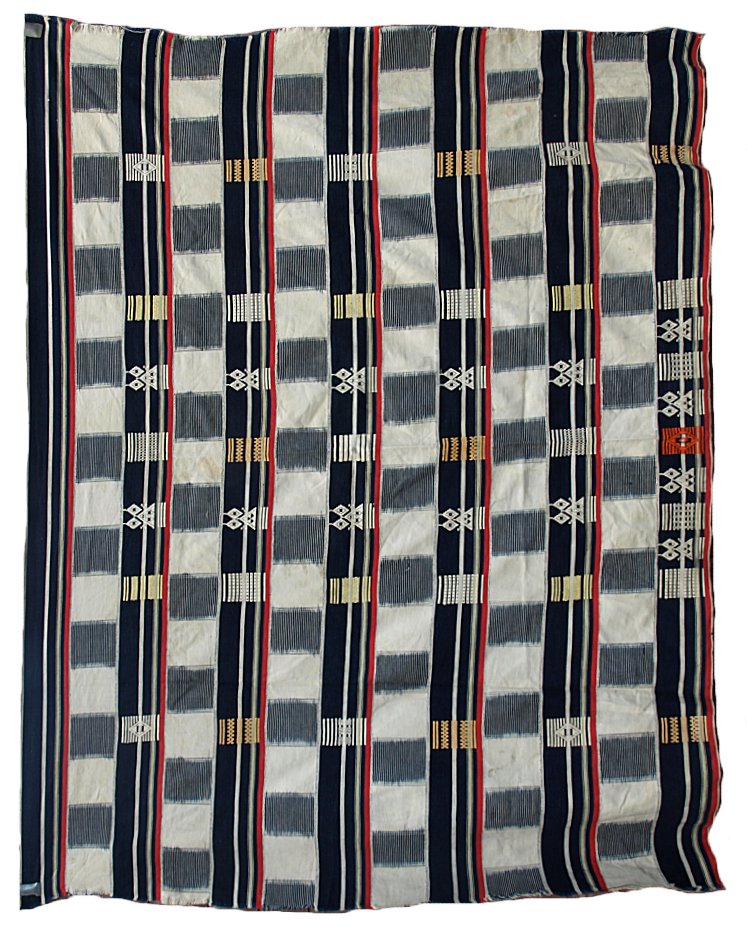
Showing posts with label Bondoukou. Show all posts

Friday, 28 February 2014

French National Archives–historic images of West African textile production.

Now online from the French Archives nationale d’outre-mer are over 5000 images taken before the 1960s in France’s former African colonies. Among the other treasures in this important resource are a number of superb images of aspects of textile production in West Africa. A few highlights are shown below.
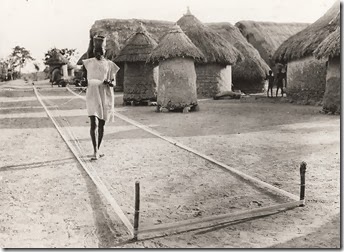
DAFANCAOM01_30FI002N002_P

“The weaver prepares his thread” Bobo-Dioulasso, Burkina Faso, 1930-60.

DAFANCAOM01_30FI002N004_P

“Young Bobo girl spins thread”, photographer Berthier (Joseph, Louis), Burkina Faso (1945-1961)
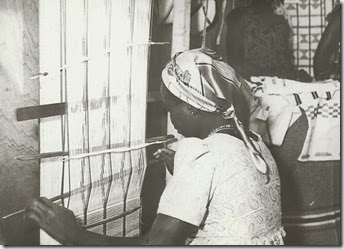
DAFANCAOM01_30FI002N007_P

“Loom” Burkina Faso, 1959 – some kind of craft training school probably.

DAFANCAOM01_30FI002N009_P

“Dyers” photographer Chéron (Georges, Gustave, René) (1882 – ?), Kaya, Burkina Faso, (1908-1934)
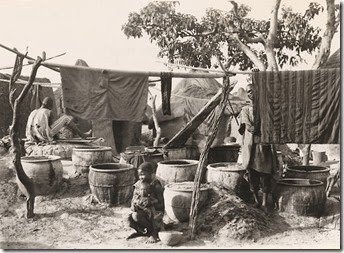
DAFANCAOM01_30FI002N010_P

“Dyers” – Bobo Dioulasso, Burkina Faso.

DAFANCAOM01_30FI035N050_P

“Tukolor weavers” photographer Puigaudeau (Odette du) (1894-1991), Selibaby (Guidimakha),Mauretania, 1934.

DAFANCAOM01_30FI019N008_P

“Hausa embroiderer”, Niger, before 1930.

DAFANCAOM01_30FI059N063_P

“Weaving fibres of “liane floria”” photographer Krull (Germaine) (1897-1985), Bafoussam, Cameroon, 1943

DAFANCAOM01_30FI025N030_P

“Diola-Floup weaver” Ziguinchor, Senegal, before 1960.

DAFANCAOM01_30FI010N061_P

“Weavers” photographer Verger (Pierre) (1902-1996), Bamako, Mali, 1935/36.

DAFANCAOM01_30FI078N043_P

“Weaving bands of ‘galak’” Chad, 1932.
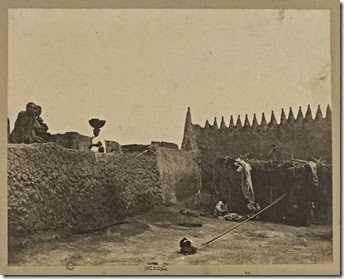
FRANOM15_037FI_00N562BS

“Weaver prepares his equipment” photographer Marcel Monnier, Bondoukou, Ivory Coast, 1892.

FRANOM15_037FI_00N614

“Sudanic loom” photographer Marcel Monnier, Ivory Coast, 1892.

Thursday, 15 August 2013

Revisiting some exceptional Bondoukou textiles from Ivory Coast.

bond09

Agnibilécro - Kangah, Chef Agnis. Postcard photographed by G. Kante, circa 1920. The seated ruler wears a Bondoukou style cloth. Author's collection.

This post features an important and very rare group of cloths from the north eastern part of Cote D'Ivoire, around the town of Bondoukou. Stylistically and historically related to the well known Ewe and Asante cloths of Ghana these distinctive early C20th cloths are previously undocumented and not represented in museum collections (except a few we have sourced in recent years.) They represented an important stylistic and historical link between the textiles of Mali and Ivory Coast and those of Ghana. The area we found these cloths is sparsely populated and it would appear that most existing examples have now been collected. For more information please see my article on Bondoukou cloths from Hali magazine, 2008, now online here.

fr473

fr473 - One of a very small number of museum quality Bondoukou men's cloths that we have collected over recent years, this subtle and beautiful piece uses complex blocks of coloured weft threads muted by the predominant indigo warp as the sole decorative effect. Although this is a very old decorative technique found in some of the earliest Ghanaian textiles the sophisticated effect achieved here by varying the colours and the placement of blocks is to my knowledge unique. More details here.

fr479

fr479 - This rare men's hand spun cotton wrapper cloth illustrates a style of weaving in the Bondoukou area with simple, almost rustic, geometric weft float motifs bordered by weft faced blocks in bold simple colours. Very few complete man's cloths with this degree of pattern have been collected and this example is in great condition, with a single small patch on a worn edge. Dates from about 1950. More details here.

fr474

fr474 - Superb men's hand spun indigo-dyed cotton ground wrapper cloth collected in a village in the vicinity of Bondoukou in northeast Côte D'Ivoire. One of the finest of the small number of top cloths from this area we collected in 2006 and 2007 when these textiles first began to become available. This exceptional piece was published full page in Hali #157, Autumn 2008. Regular lines of colour across the cloth are created by weft faced bands on alternate strips that are joined by narrower pairs of weft stripes on the other strips. At the centre the design is expanded into a row of complete pattern blocks in which weft faced bands frame supplementary weft float motifs. These motifs, which differ in form from Ghanaian styles, include two animals. The layout of pattern in bands across the field of the cloth separated by undecorated areas is a design that would not occur on Ewe or Asante weaving. More details here.

fr502

fr502 - Superb early example of man's wrapper cloth from the Bondoukou region. Illustrates two of the distinctive aspects of pattern layout within this tradition that differ from those of the Asante and Ewe in Ghana, namely a focus on the centre of the fabric and an alignment of patterns in rows down the cloth (rather than the chequerboard type layout typical in Ghana.) This exceptionally fine piece appears to be among the earliest we have seen from the Bondoukou area. Woven with a hand spun indigo dyed cotton background with very subtle balance of warp and weft stripes. More details here.

Click on the photos to enlarge. For more of our collection please visit our gallery online here.

Wednesday, 3 April 2013

Cloth of the month–an exceptional Bondoukou man’s cloth.

fr473

fr473 - One of a very small number of museum quality Bondoukou men's cloths, this subtle and beautiful piece uses complex blocks of coloured weft threads muted by the predominant indigo warp as the sole decorative effect. Although this is a very old decorative technique found in some of the earliest Ghanaian textiles the sophisticated effect achieved here by varying the colours and the placement of blocks is to my knowledge unique. One strip is missing from each edge (they were likely removed because they were excessively frayed) but the cloth is otherwise in very good condition with no patches, holes, or stains. Dates from C19th or early C20th. Measurements: 118ins x 71ins, 300cm x 180cm. PRICE: Email for price.

fr473d

fr473d1

Bondoukou is in the north east of Ivory Coast, not far from the border with Ghana. Culturally and historically  it shares many features with the nearby Brong-Ahafo region of Ghana, such as small Akan kingdoms and chieftaincies ruling primarily farming peoples and significant communities of Muslim traders of Malian ancestry. The textiles of this region, as I discussed in my article in Hali magazine a few years ago, now on my website here, share features with both Asante and Ewe cloths from Ghana and with Ivoirian cloths of the Guro and Baule.

Two cloths from the collection of the Museum de Kulturen, Basel, published in the important exhibition catalogue Woven Beauty: The Art of West African Textiles edited by Berhard Gardi (Basel, 2009) illustrate the early use of the same technique.

Basel1

This cloth, collected in 1840, is the oldest documented kente in the world. Here red, yellow, and blue weft stripes are muted by the white warp. The author notes that it may be attributed to either an Asante or an Ewe weaver – although I would suggest the red edge strip is strongly indicative of an Ewe origin.

Basel2

This second piece, collected in 1886, is attributed by the author to the Asante on the rather weak grounds that the collection location is nearer Asante than it is to the Ewe. It is closer to our cloth in that indigo and white stripes are used in the warp although the variety of weft colours is still much less, and the pattern layout much less sophisticated. Click on the photos to enlarge. More Bondoukou cloths on our website here.

Saturday, 15 September 2012

Minimal Four–another Bondoukou men’s cloth

fr505

In this series of posts I will highlight some rare West African textiles where the elaboration and complexity of design that usually typifies high status textiles is replaced by a more minimal aesthetic….

fr505d

fr505 - Superb man's cloth from the Bondoukou region with very unusual and subtle minimal design. On a neat hand spun indigo dyed cotton ground the weaver has carefully aligned rows of narrow diamond shaped supplementary weft float patterns. On the second to last row from the bottom of the cloth the colours are reversed. In excellent condition. Dates from early C20th. Measurements: 110ins x 76ins, 280cm x 193cm.

FR505d1

Click on the images to enlarge.

For more information please visit our gallery of Ivory Coast textiles here

Friday, 14 September 2012

Minimal Three – Bondoukou man’s cloth

FR527

In this series of posts I will highlight some rare West African textiles where the elaboration and complexity of design that usually typifies high status textiles is replaced by a more minimal aesthetic….

FR527d

FR527 - Unusual man's cloth from the Bondoukou region of northern Ivory Coast with a simple but graphically strong design of blocks of blue and yellow wefts on a background of white and blue hand spun cotton. This is the only white ground men's cloth I have seen, although we have collected several smaller white women's cloths. In excellent complete condition, dates from circa 1930-50. Measurements: 100ins x 66ins, 255cm x 169cm.

FR527d1

Click on the images to enlarge.

For more information please visit our gallery of Ivory Coast textiles here

Friday, 20 January 2012

African Textiles in Africaniste Art–an unusual case.

vettiner

Marché en A.O.F. signed J.B. Vettiner, 1931. [click all images to enlarge]. From Christie’s sale The Africanists, Amsterdam 1 July 1998. Oil on canvas, preparatory work for a mural painted in the pavilion of the city of Bordeaux at the 1931 International Colonial Exhibition in Paris.

Although this is in most respects a typical colonial genre scene of no outstanding merit, it is unusual because of the detail and accuracy with which the artist has depicted the textiles worn by the participants. Moreover the textiles shown are in several instances extremely rare styles not well represented even in French museum collections. I am intrigued to find these cloths shown in this context and can’t help wondering if they have survived in an obscure French collection, perhaps in Bordeaux, to this day. The scene was clearly not drawn from life – there is no suggestion in the limited biographical information available on the artist, Jean-Baptiste Vettiner (1871-1935), that he travelled in West Africa, and the cloths shown are far too elaborate and expensive to have been worn by porters in the market. Gathering cotton was a frequent theme of colonial imagery as the postcards dating to circa 1910-20 below show.

cotton

cotton1

So what can be said about these cloths ? The image below numbers the main pieces.

vettinerguide

1. Wool kaasa blanket from Mali, of the lanndaaka type, with the central motif of the mosque, lanndal, woven by a maabo weaver. Shown  wrongly worn vertically as a kind of hooded burnous rather wrapped horizontally. The kaasa lanndaaka below is in the National Museum of Mali, Bamako – see Textiles du Mali, Bernhard Gardi, 2003.

kaasa

2 and 4. Indigo dyed cotton cloths with white warp stripes at the selvedge of each strip and coloured supplementary weft float motifs are typical of the Bondoukou region on the northern part of the Ghana/ Côte D'Ivoire border, where they were woven by Dioula, and perhaps Abron or Koulango weavers. The cloth below is on our gallery.

fr479

3 and 6. These are really obscure types, related to weft faced cloths woven in West and north west parts of Côte D'Ivoire by weavers who may be Guro, Mande or Dioula, working in a number of as yet undocumented local traditions. The Musee Quai Branly in Paris has a superb collection of related pieces, although unfortunately largely without much useful collection data. Search for Côte D'Ivoire  in their textiles collection database to see more. They have the piece below as Senufo but that is unlikely as the Senufo learned weaving from the Dioula in the early decades of the C20th.

mqb

5. Also from Côte D'Ivoire this cloth is an example of a slightly better known but still rare style that we believe to be the work of Guro or Mande weavers. The example below is on our gallery now.

fr492

7. One of the more unusual types of Malian blanket, the arkilla bammbu would have been used as a prestige display hanging for a Fulani wedding and is most unlikely to have been worn at all. The detail below is from a cloth in the National Museum of Mali, Bamako – see Textiles du Mali, Bernhard Gardi, 2003.

arkilla

8. This cloth has embroidered rather than woven decoration, probably the work of a Hausa embroiderer in the north of Côte D'Ivoire. I know of only one related example of this style on a man’s wrap cloth (rather than robes and trousers). Now in the Karun Thakar collection (www.karuncollection.com) it was acquired in Accra and probably collected in northern Ghana.

CNV00036

Tuesday, 17 November 2009

The "Spotted Hyena" - Dioula ikat weaving in northern Ivory Coast

A Dioula weaver at work in the square beside the mosque, Bobo-Dioulasso, Burkina Faso. Vintage postcard, circa 1910, author's collection.


The Dioula or Dyula are a Muslim Mande-speaking people who migrated from present day Mali into what is now northern Cote D'Ivoire and southern Burkina Faso in the sixteenth century. Specialists in long-distance trade, Islamic scholarship, and textile production the Dioula were key players in the distribution of weaving technology throughout West Africa. Dioula weavers wove cloths for their own use and for trading both locally to farming peoples such as the Senufo and Koulango, and as trade goods for their long distance caravans south to the Guinea coast and east via Bondoukou to Salaga in northern Ghana.

Key features of Dioula weaving were complex supplementary weft float motifs, the early introduction of imported red threads, and at least from the end of the C19th, the use of ikat (ikat was rare in West African weaving - the Yoruba in Nigeria were the other main practitioners of the technique.) The "spotted hyena" or "suruku kawa" was the Dioula name for the oldest of their warp ikat patterned designs, in which solid blocks of indigo blue across the whole strip width alternated along the cloth with the white cotton ground. These ikat decorated strips could be used to create an overall checker board layout of alternated with warp striped or check patterned strips.


"Elegantes de Kong" (Prouteaux 1925, p.608)


In the second half of the C20th hand-woven cloth was no longer part of everyday dress but was still in demand for weddings, festivals, and other ceremonial occasions. The suruku kawa pattern was no longer fashionable and was displaced by other ikat designs developed mainly by the Baule who had taken over and elaborated the Dioula technique.


An elderly Dioula weaver, Dar Salami, south Burkina Faso, 2004 (auther's photograph.)


Dioula cloths were not widely collected and are poorly represented in museum collections, with the exception of Basel Museum, where a number of important pieces are included in their current exhibition "Woven Beauty." We have now posted on our gallery website a fine group of mid-C20th examples collected in north east Cote D'Ivoire. For details and prices see our page here. For more on Dioula weaving see chapter by Dr Kerstin Bauer in the Basel exhibition catalogue here.

Thursday, 1 October 2009

Our Web Gallery Updated


After a busy summer of travelling we now have new stock posted throughout our web gallery and available at our London shop. A few highlights are shown below.


Ewe weaving from Ghana


Ewe cloth come from the Volta region of Ghana and bordering areas of Togo. They are among the most sought after vintage African textiles by museums and collectors. Woman wear two small cloths of the same design while men wear one large cloth toga fashion. E503: The slightly narrower than normal strips, together with the threefold grouping of weft faced blocks are an archaic style and indicative of an early C20th or earlier date for this cloth despite its pristine condition. Much African textile design is about exploring the tension between similarity and difference within the self-imposed constraints of the design. In this case the weaver restricts both the weft blocks and weft motifs to a limited palette of red, yellow, white, and blue, but varies the choice of motifs and the order of the weft stripes within the pattern blocks throughout. More Ewe cloths here

Nigerian Women's Weaving.
Nigerian women used a different type of loom to the man's narrow strip device found throughout West Africa, weaving wider panels of fabric.
NW396: Woven by Ijebu Yoruba women in the town of Ijebu-Ode and its surroundings, these extraordinary cloths are used as insignia of office by Ijebu chiefs and members of a society known as Ogboni (which in the past had responsibilities for the worship of the Earth deity and advised the king.) The designs represent various important spirit familiars including frogs, crocodiles etc. This four panel indigo dyed blue and white type, woven from thick hand spun local cotton is very rare. The right hand panel has at some point been cut near the centre and stitched back together, but otherwise condition is excellent. Dates from circa 1900-20. More Nigerian women's cloths here

Francophone African Textiles

At the moment we are focussing on Cote D'Ivoire and in particular on obscure and rare cloths from the north east of the country on the border with Ghana. Fr402: One of the finest and most elaborate of the small group of woman's wrapper cloths we have collected from the Bondoukou region. Woven with a hand spun indigo dyed cotton background the design has a regular alternation of weft float motifs framed by red, white, or blue weft faced blocks. Well worn and with one small area of damage to a float pattern - see detail, this exceptional cloth is in good overall condition. Dates from early C20th. More Francophone African cloths here