Monday, 21 December 2009

Strip Weave Cloth Sample Packs

stripsamples

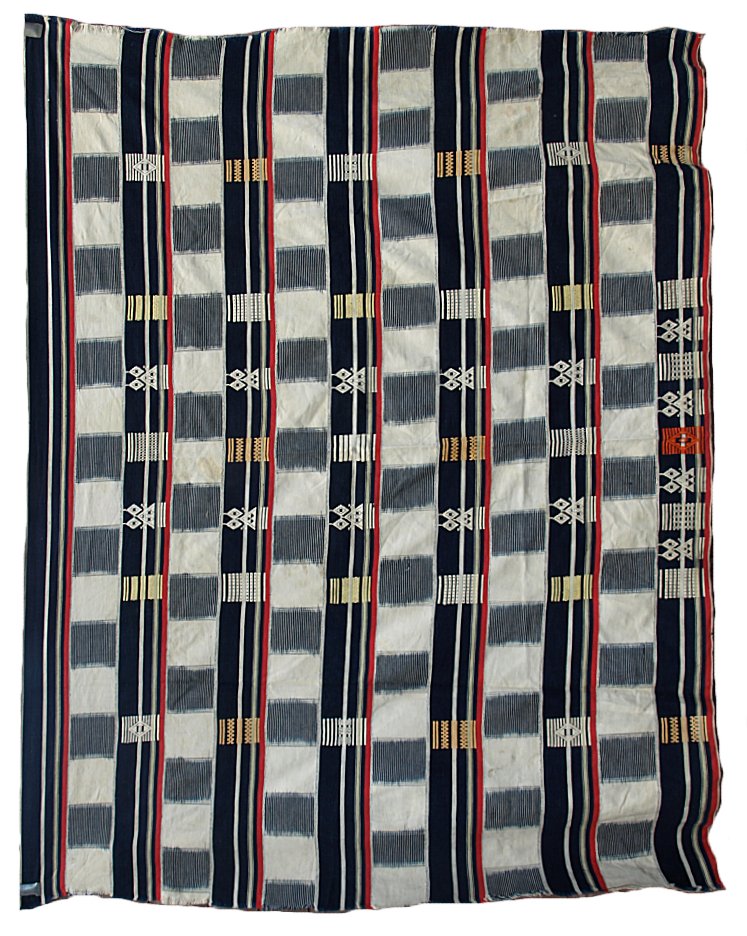
Over the years a number of people have asked us for packs of sample pieces of strip woven cloth. These are a good educational resource providing a way to learn about patterns, techniques etc, as well as a useful source for collectors, quilters, and textile artists. We can put together mixed packs of strip pieces of average length about 10ins/25cm to include Asante and Ewe kente, Yoruba aso oke and others. Cloths will date from 1900 to 1990s, with most before 1950. These will be similar but not identical in content to the one illustrated. More details here

Friday, 18 December 2009

New Book on photography in Central Africa

bechaud Auguste Bechaud – Photographe-soldat en Afrique centrale by Didier Carite (Le Portfolio, 2009)

This is an important and interesting addition to the growing body of literature on early photography and postcards in Africa. Includes fascinating images of dress, tattooing, and body decoration among the Sango, Ngbugu, Yakoma, and other Central African peoples at the start of the C20th, along with some other more disturbing photographs such as the aftermath of an elephant hunt.

bechaud1 Young woman of the Gbanziri
bechaud2 Femmes d’europeans

I was particularly pleased to learn more about the origins of the above image because it has intrigued me as a postcard for some time. The lady on the left (click on the photo for a larger view) is wearing an especially elaborate strip woven wrapper cloth that certainly was not produced in central Africa. Last year in Basel Bernard Gardi and I disagreed about its origins – he thinks it is from Sierra Leone, where Mende and Vai weavers do produce cloths with blocks of oval cell-like float patterns as seen here. To me though, it looks like the work of Jukun or related weavers in the Benue valley of eastern Nigeria – they also wove the “cell” pattern but additionally the weft stripes framed by lines of weft floats. Either way it has clearly travelled far from its origins, providing a salutary reminder of the mobility of prestige textiles within Africa in the early colonial period.

The book should be available from amazon.fr or Soumbala or failing that direct from the author. Contact me for his email.

Thursday, 17 December 2009

Artistes d'Abomey at musee du quai Branly

Until 31 January 2010 there is a superb exhibition at the musee du quai Branly, Paris, focussing on the court artists who supplied the dramatic sculpture, banners, robes etc. to the powerful Fon kingdom at Abomey in the Republic of Benin. Alongside iconic statues such as the celebrated royal "bocio" figures the exhibition provides African textile enthusiasts this provides a rare opportunity to see part of the worlds two major collections of the celebrated Fon appliqué banners, including some examples (not shown here) presented by the Fon king to the French Emperor Napoleon III in 1865.


Also of note are two fine examples of embroidered robes worn at the Abomey court. Embroidered on strip woven cloth, as in this piece, or on imported fabric, the specific cut and embroidery layout of these robes is distinctive to the Fon, despite affinities with other types in the family of West African prestige robes.


This strip woven cloth is the only example I know of in the style. According to the collection data it is said to have been woven by Yavedo and Goyomo, two wives of the Fon king Ghezo and formed part of the presentation to Napoleon III in 1865.

There is an interesting booklet "Artistes d'Abomey" (Beaux Arts editions) that accompanies the show, and a catalogue with the same title that appears not yet to be available. More info here.

Wednesday, 16 December 2009

Tuesday, 15 December 2009

More Nigerian Textiles...Jukun, Gwari, Yoruba


Just back from a brief trip to Nigeria...
Some of the new posts from our website


CODE #: AS350
PRICE: US$675

Measurement: 84ins x 50ins, 214cm x 127cm

Typical example of the elaborate and complex supplementary weft float patterning once practised by weavers of the Jukun people of the Benue valley in Eastern Nigeria. Collected some years ago in the vicinity of the Jukun capital of Wukari. Jukun cloths are not well documented and are rarely available on the market. This piece is in excellent condition and dates from 1950-60. It may be compared to a piece collected in 1965 illustrated in Sieber "African Textiles and Decorative Arts" (MOMA 1972 page 188.)


CODE #: AS353
PRICE: US$1100
Measurements: 78ins x 57ins, 198cm x 144cm

Superb and rare early C20th woman's wrapper. Each strip combines fine hand spun indigo checked "etu", "guineafowl pattern," with magenta "alaari" - silk from the trans Saharan trade. It would have been an extremely expensive and prestigious cloth in its day. In searching for these early cloths I look for pieces where all the original hand stitching is intact, as here. After almost a century many have begun to come apart at the seems and been restitched using a sewing machine, often in a less than careful way. Intact pieces like this have a pleasing completeness but are extremely rare. Dates from circa 1900-1920 and is in excellent condition.


CODE #: AS349
PRICE: US$785
Measurement: 65ins x 32ins, 164cm x 81cm

Woman's wrapper from the Gwari people of central Nigeria - the once obscure and remote Gwari ancestral homeland is now the site of the modern Nigerian capital of Abuja and many Gwari farmers have been displaced. These are among the strangest cloths to be found in Nigeria. Woven for the Gwari by weavers of Hausa ancestry the hand spun indigo dyed strips have regular rows of open work, broken up at a few places by blocks with a different openwork arrangement. The woven strips are then joined using a complex braiding technique that adds a long narrow open area between each strip except at the lower edge. This treatment of strips is as far as is known, unique to the Gwari. It creates a strange highly textural cloth that is oddly appealing. In excellent condition dates from around mid C20th or earlier.

Wednesday, 25 November 2009

Hand woven textiles in Cote D'Ivoire today..

Côte D’Ivoire is home to a fascinating diversity of textile production traditions, the vast majority of which have hardly begun to be researched. Aside from the tie dyed raffia cloths of the Dida people, most of which incidentally are actually very newly made for export sale, the collectors' market has paid little attention to Ivoirian fabrics. Over the past decade the Civil War and the uneasy peace in a divided country that has followed have made further research difficult or impossible. For this reason I was very interested in the glimpses of contemporary cloth production and use provided by the photos and short texts in a newly published book. Somewhat misleadingly titled "Arts au feminin en Côte D’Ivoire", edited by Philippe Delanne, (le cherche midi, Paris, 2009) this is a glossy government endorsed survey subsidised by the UNFPA. Alongside printed fabrics it shows people at celebrations and events wearing a wide variety of locally woven cloths. By the far the most widely illustrated are modern Baule ikat dyed cloths as shown in the first photo.
The Baule are an Akan people who migrated to their present location in central Côte D’Ivoire from Ghana in the C16th but seem only to have learnt weaving from their Dioula neighbours in the early to mid C20th. Note the standing posture of the weavers in the photo, unlike the seated style of the Asante and Ewe in Ghana. The book notes that there are around 300 weavers in a cooperative group in the village of Bomizambo 45km from Yamoussoukro.

In contrast to the Baule, the weaving of the Dan people in the central western part of the country is very obscure. Perhaps surprisingly given the attention paid to Dan masks and sculpture I am not aware of any published images before this that show Dan textiles and weaving.


Some modern Gouro cloths worn for a wedding. The lady in the centre is wearing a Baule cloth, but the woman at the left and 2nd from right wear complex weft float decorated Gouro fabrics.


Finally, a Malinké masquerader near Bondoukou wears a modern Abron cloth.

For a selection of our vintage textiles from Côte D’Ivoire see here and for further reading see here

Tuesday, 17 November 2009

The "Spotted Hyena" - Dioula ikat weaving in northern Ivory Coast

A Dioula weaver at work in the square beside the mosque, Bobo-Dioulasso, Burkina Faso. Vintage postcard, circa 1910, author's collection.


The Dioula or Dyula are a Muslim Mande-speaking people who migrated from present day Mali into what is now northern Cote D'Ivoire and southern Burkina Faso in the sixteenth century. Specialists in long-distance trade, Islamic scholarship, and textile production the Dioula were key players in the distribution of weaving technology throughout West Africa. Dioula weavers wove cloths for their own use and for trading both locally to farming peoples such as the Senufo and Koulango, and as trade goods for their long distance caravans south to the Guinea coast and east via Bondoukou to Salaga in northern Ghana.

Key features of Dioula weaving were complex supplementary weft float motifs, the early introduction of imported red threads, and at least from the end of the C19th, the use of ikat (ikat was rare in West African weaving - the Yoruba in Nigeria were the other main practitioners of the technique.) The "spotted hyena" or "suruku kawa" was the Dioula name for the oldest of their warp ikat patterned designs, in which solid blocks of indigo blue across the whole strip width alternated along the cloth with the white cotton ground. These ikat decorated strips could be used to create an overall checker board layout of alternated with warp striped or check patterned strips.


"Elegantes de Kong" (Prouteaux 1925, p.608)


In the second half of the C20th hand-woven cloth was no longer part of everyday dress but was still in demand for weddings, festivals, and other ceremonial occasions. The suruku kawa pattern was no longer fashionable and was displaced by other ikat designs developed mainly by the Baule who had taken over and elaborated the Dioula technique.


An elderly Dioula weaver, Dar Salami, south Burkina Faso, 2004 (auther's photograph.)


Dioula cloths were not widely collected and are poorly represented in museum collections, with the exception of Basel Museum, where a number of important pieces are included in their current exhibition "Woven Beauty." We have now posted on our gallery website a fine group of mid-C20th examples collected in north east Cote D'Ivoire. For details and prices see our page here. For more on Dioula weaving see chapter by Dr Kerstin Bauer in the Basel exhibition catalogue here.