


More images, details and pricing here
Thursday, 27 January 2011


Friday, 14 January 2011
Conversation Pieces: African Textiles from Barbara and Bill McCann’s Collection
Yesterday I inadvertently posted the wrong description for this exhibition. Below are the details with the correct text, together with a photo of one of the exhibited cloths, kindly provided by Barbara McCann.

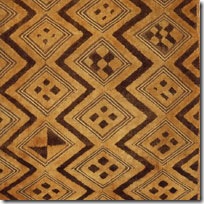
Detail of an Akwete woman’s wrapper cloth, Nigeria, from the collection of Barbara and Bill McCann.
Conversation Pieces: African Textiles from Barbara and Bill McCann’s Collection
Curated by Catherine Hale
Carleton University Art Gallery, Ottawa, Canada
February 14, 2011 - April 17, 2011
“Conversation Pieces explores the vital role played by conversation and, more broadly, communication, in the acquisition, understanding and exhibition of textiles from the McCanns’ rich and varied collection. The exhibition presents approximately sixty textile works and a wide range of garments acquired by the McCanns since 1970, in countries from Morocco to South Africa, as well as Mr. and Mrs. Andrews without their Heads (1998), a textile-based installation work by contemporary artist Yinka Shonibare, loaned by the National Gallery of Canada.
Whether created as emblems of prestige, to commemorate particular events or individuals, to offer protection, or to identify a rite of passage, textiles and clothing throughout the African continent are actively employed to communicate concepts of identity, history, and community. Highlights of the exhibition include an intricately-appliquéd raffia woman’s skirt from the Democratic Republic of Congo, a cotton hunter’s shirt from Mali adorned with leather amulets and mirrors, a richly-embroidered cotton man’s gown from Nigeria, a Moroccan wool hooded cloak featuring a vivid red “eye” motif, and a three-part bridal outfit (smock, shawl and trousers) from Egypt’s Siwa Oasis region. Conversation Pieces highlights the many ways that textiles initiate dialogue about and between people in Africa and elsewhere. A catalogue is planned.”
Thursday, 13 January 2011

Wednesday, 12 January 2011
African Textile Exhibitions in 2011 by opening date..
Africa Interweave: Textile Diasporas
Samuel P. Harn Museum, University of Florida
February 8, 2011 - May 8, 2011
”Whether worn for work, masquerades, sacred ceremonies, or adorning the home or shrine, textiles are one of the most vibrant art forms on the African continent. Textiles have rich and diverse cultural histories. The exhibition will illustrate the continuity of textile designs and techniques from past to present, highlighting innovations, contemporary fashion and works inspired by traditional practices.
Art on display in the exhibition will be selected from the Harn collection, with many newly acquired works, including those recently commissioned from African textile artists. Loans from private collections and other institutions will also enhance the exhibition.”

Conversation Pieces: African Textiles from Barbara and Bill McCann’s Collection
Curated by Catherine Hale
Carleton University Art Gallery, Ottawa, Canada
February 8, 2011 - May 8, 2011
”Whether worn for work, masquerades, sacred ceremonies, or adorning the home or shrine, textiles are one of the most vibrant art forms on the African continent. Textiles have rich and diverse cultural histories. The exhibition will illustrate the continuity of textile designs and techniques from past to present, highlighting innovations, contemporary fashion and works inspired by traditional practices.
Art on display in the exhibition will be selected from the Harn collection, with many newly acquired works, including those recently commissioned from African textile artists. Loans from private collections and other institutions will also enhance the exhibition.”
Global Patterns: Dress and Textiles in Africa
Museum of Fine Arts, Boston
April 13 2011 – January 8 2012
“This exhibition focuses on the accomplishments of African weavers, dyers, bead embroiderers, and tailors, and highlights continuities, innovation, and the exchange of ideas from within and without that mark dress and textile production in Africa. More than any other artistic expression, dress and textile production in Africa demonstrates the continuous links of the Continent with the outside world. Throughout centuries, African textile artists seamlessly and joyfully integrated into their visual vocabulary new design elements and new materials such as glass beads, buttons, and fabrics that arrived as the result of trade with Europe and places as far away as India and Indonesia. They added to or transformed existing traditions, and at times created new types of textiles and garments. Beadwork among the Ndebele peoples of South Africa and the Yoruba peoples of Nigeria, Kente cloth in Ghana and Togo, and Yoruba indigo-dyed cloths called Adire are among the highlights of the display.
Africans, in particular those living along the coasts, have been in contact with Europeans and other foreigners since the sixteenth century. Therefore, it is not surprising that clothing styles common in Europe also appeared early on among African elites. Certainly by the late nineteenth century, when many African regions had come under colonial rule, salaried employees who worked for colonial administrations, merchants, and increasingly the educated residents of growing urban centers were aware of fashion trends in Europe and began to follow them. They picked and chose inventing new hybrid styles, and always went with the times. Trade cloth and photographs help explore these aspects of African creativity.
The adoption of new ideas was not a one-way street, however: a small section in the exhibition demonstrates the way in which Europeans and Americans were equally intrigued by African dress and adornment. By the 1920s, African forms inspired fashions and design on both continents, part of creative exchanges that continue to this day.”

Weaving Abstraction:
Kuba Textiles and the Woven Art of Central Africa
The Textile Museum, Washington
October 15, 2011 through February 19, 2012
“The textiles of the Kuba kingdom are among the most distinctive and spectacular works of African art. Emerging in the early 17th century, the Kuba kingdom grew into a powerful and wealthy confederation of 18 different ethnic groups located in what is now the Democratic Republic of Congo. While they have fascinated artists, collectors and designers for over a century, this will be the first major museum exhibition in the U.S. to showcase the artistic inventiveness and graphic power of Kuba ceremonial dance skirts within a wide-ranging survey of Kuba design. More than 50 exceptional 19th- and early 20th-century objects will be on view, including ceremonial skirts, ‘velvet’ tribute cloths, headdresses and basketry from the permanent collection of The Textile Museum, the National Museum of African Art, and several private collections.”
Please do let me know if you are aware of others….
Friday, 31 December 2010
Fante Asafo Flags on display in Genoa
As part of the exhibition “The Wonders of Africa: African Art from Italian Collections” that opens today at the Palazzo Ducale, Genoa, sixteen exceptional Fante Asafo flags will be on display until 5 June 2011. Drawn from an important private collection, this selection highlights the artistry of Fante flagmakers working in the first half of the twentieth century. Please do not reproduce the images below without permission.


%20small%5B3%5D.jpg "repertorio definitivo (3) small")
%20small%5B77%5D.jpg "repertorio definitivo (9) small")
%20small%5B3%5D.jpg "repertorio definitivo (10) small")
There is an excellent publication “Asafo” by Federico Carmignani that illustrates the collection and introduces new research. Text is in English and Italian. Available from the publishers here.

If you are interested in collecting Asafo flags please take a look at my earlier post on real and fake flags here and the selection in our gallery here.
Saturday, 11 December 2010
Ancestral indigo cloths of Saint-Louis
 | Ceremonial shawl, Senegal, early C20th. (private collection, London). Click any photo to enlarge. |
To mark the current ceremonies for the 350th anniversary of Saint-Louis, Senegal, I am looking today at one of my favourite types of West African textile, the intricate resist-dyed indigo shawls that were once a speciality of Wolof women in Saint-Louis.
Since the late C16th Portuguese settlers on the Cape Verde archipelago organised enslaved weavers from the Guinea coast to produce strip woven cotton textiles that were a vital commodity in the trading strategies of Portuguese trading posts along the West African coast. The most complex of these panos (pagne, cloths) had designs inspired by Hispano-Moorish textiles from the Iberian peninsular adapted to the narrow-strip weaving tradition of West Africa. They were the design forbearers of the Mandjak weaving tradition noted in the previous post. Most of the published literature on these textiles is in Portuguese but there is an important recent article by Carlos F. Liberato “Money, Cloth-Currency, Monopoly, and Slave Trade in the rivers of Guine and the Cape Verde Islands, 1755-77,” online here
 | Af1934,0307.194, Beving Collection, British Museum. circa 1900. |
 | Rare view of a Cape Verde panos in use, worn at a batuque dance. Detail of a vintage postcard, circa 1905, authors collection. |
The Senegalese indigo dyed cloths we are looking at here seem to have developed from attempts, perhaps in the nineteenth century or even earlier, to replicate these complex and expensive woven design using a cheaper embroidery resist technique. drawing on long established traditions of more simple tie dyed cloth patterning in the Senegambia area. Imported cotton cloth, often cut up into narrow strips for patterning, or with patterns that echoed the narrow strip designs, were embroidered by hand with intricate motifs. The cloth was then dyed in indigo, and as a final stage, the embroidered motifs cut away with a razor blade or sharp knife, to leave white designs on a blue ground.
 | Illustration of embroidered resist technique. Click to enlarge. From the catalogue “Teinture, expression de la tradition en Afrique noire” (Musee de l’Impression sur Etoffes de Mulhouse, 1982) |
 | British Museum photo showing various stages of production. Af1934, 0307.351 |
The result of this laborious and painstaking work were some of the most beautiful of West African textiles.
 | Ceremonial shawl, Senegal, early C20th. (private collection, London.) |
 | Ceremonial shawl, Senegal, early C20th. (author’s collection.) |
Below are a series of early C20th images from vintage postcards that show the cloths in use…..
 |  |
 |  |
 |  |
 |  |
 |  |
Sunday, 5 December 2010
Mandjak Textiles exhibition in Saint-Louis, Senegal


“Saint-Louis du Sénégal
Salle de conférence de « La Maison Rose »
10 décembre - 31 décembre 2010
Exposition « Pagnes … Panos »
Pagnes … Panos … est une exposition itinérante de textiles d’une tradition pluriséculaire appelés « pagnes Mandjak ». Organisée par Maï Diop, designer textile française installée à Saint-Louis depuis 12 ans, cette exposition fait l’objet d’un intérêt croissant des amateurs, collectionneurs et musées. Une sélection de 4O pièces venant de Guinée Bissau, du Cap vert et du Sénégal où Saint-Louis capitale de l’élégance est très représentée, a été choisie parmi la collection de l’organisatrice.
Cette exposition se distingue par la richesse tant au plan des techniques employées que de la finesse des pagnes : supports d’affectivité, de superstitions et de noblesse, ces majestueuses étoffes sont produites par d’excellents tisserands encore aujourd’hui.
Dans le cadre des célébrations de Saint-Louis, dont l’année anniversaire des 350 ans touche à sa fin, cette exposition est une invitation à découvrir et à porter un nouveau regard sur ces textiles africains : ils ont les qualités des femmes qui en dirigent la production : l’élégance, le dynamisme, la créativité. “
Subscribe to:
Posts (Atom)