Saturday, 15 September 2012

Minimal Four–another Bondoukou men’s cloth

fr505

In this series of posts I will highlight some rare West African textiles where the elaboration and complexity of design that usually typifies high status textiles is replaced by a more minimal aesthetic….

fr505d

fr505 - Superb man's cloth from the Bondoukou region with very unusual and subtle minimal design. On a neat hand spun indigo dyed cotton ground the weaver has carefully aligned rows of narrow diamond shaped supplementary weft float patterns. On the second to last row from the bottom of the cloth the colours are reversed. In excellent condition. Dates from early C20th. Measurements: 110ins x 76ins, 280cm x 193cm.

FR505d1

Click on the images to enlarge.

For more information please visit our gallery of Ivory Coast textiles here

Friday, 14 September 2012

Minimal Three – Bondoukou man’s cloth

FR527

In this series of posts I will highlight some rare West African textiles where the elaboration and complexity of design that usually typifies high status textiles is replaced by a more minimal aesthetic….

FR527d

FR527 - Unusual man's cloth from the Bondoukou region of northern Ivory Coast with a simple but graphically strong design of blocks of blue and yellow wefts on a background of white and blue hand spun cotton. This is the only white ground men's cloth I have seen, although we have collected several smaller white women's cloths. In excellent complete condition, dates from circa 1930-50. Measurements: 100ins x 66ins, 255cm x 169cm.

FR527d1

Click on the images to enlarge.

For more information please visit our gallery of Ivory Coast textiles here

Thursday, 13 September 2012

Minimal Two – more Ewe “kente”

E659

In this series of posts I will highlight some rare West African textiles where the elaboration and complexity of design that usually typifies high status textiles is replaced by a more minimal aesthetic….

E659d

Ewe659 - Superb example of a rare wide band weft faced style of Ewe chief’s cloth in exceptional condition. Dates from the late C19th or early C20th. This type of Ewe weaving is completely unresearched, although Venice Lamb does illustrate a possibly related piece with a more simple design (1975:186) she saw in Kpotoe but suggests may have been imported from the North. In my view however these cloths are clearly the work of weavers in eastern Ghana or Togo and form just one of a number of apparently anomalous cloth traditions from the eastern and northern periphery of the Ewe speaking area. I have collected a number of small women's cloths in similar styles, and seen several men's cloths that were too stained and damaged to purchase, but this is the only complete men's cloth in the style that I have seen. Hand spun local white and indigo dyed cotton in two shades in combined with imported red and mustard yellow cotton thread. Condition: The cloth is complete and intact, with its original hand stitching and no stains and holes. Size: 115 ins x 52, 292cm x 131.

E659d1

Click on the images to enlarge.

For more information please visit our gallery of Ewe textiles here

Wednesday, 12 September 2012

Minimal One –Ewe “kente”

E660

In this series of posts I will highlight some rare West African textiles where the elaboration and complexity of design that usually typifies high status textiles is replaced by a more minimal aesthetic….

E660d

Ewe660 - Exceptional nineteenth century Ewe chief’s cloth in a style called "titriku" meaning just "thick cloth." Red cotton thread purchased from European traders on the coast was highly prized by the Ewe and quickly incorporated in their design repertoire. Here it is combined with local hand spun indigo dyed and white cotton, which is an indicator of an early date - 99.9% of Ewe cloths collected use only imported thread. Although the red has faded over the years we can still note that several different shades were used giving a subtle visual variation. Note also that only one out of the hundreds of red squares has a white stripe across. Condition - has some patched repairs. Size: 115 ins x 74, 292cm x 189.

526

Click on the images to enlarge.

For more information please visit our gallery of Ewe textiles here

Friday, 7 September 2012

Tuesday, 21 August 2012

New book: African Textiles Today by Chris Spring

African Textiles Today by Chris Spring (British Museum Press), shifts the focus away from the woven textile traditions of West And Central Africa that dominated the museum’s classic but now over two decades old, African Textiles by John Picton and John Mack. Instead Spring devotes the largest part of the book’s colourful selection of images and comparatively brief and accessible texts to printed textiles, notably to the so-called “wax” and “fancy print” styles of West and Central Africa and especially to the “kangas” and related cloths made for the Eastern and Southern African markets. This shift mirrors a broadening in the British Museum’s acquisition and displays over recent years to encompass these previously neglected areas.
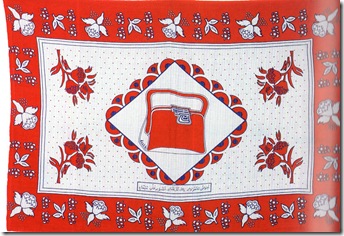
kanga

Kanga, Tanzania, 1960s. Af2003,21.1 : “The inscription, in Kiswahili written in Arabic script, reads: You left the door open, so the cat ate the doughnut; what are you going to do about it, tenant ?” page 190.

Rather than attempting an encyclopaedic survey of the myriad of textiles produced in Africa over recent decades, the book sets out a number of themes, including trade, status, communication, and systems of belief, illustrating them with brief “stories” based on individual textiles and drawn widely from across the continent. Other chapters look at the currently fashionable engagement between textiles and a number of contemporary African artists (a topic that provides the front cover image of an El Anatsui sculpture) and at textiles in photography (the back cover image of Samuel Fosso as a parody Congo chief.) Drawing on his research and publications on topics including kangas, contemporary African art, and the textile traditions of North Africa, Chris Spring is able to highlight interesting and often unexpected parallels between diverse artefacts and traditions.
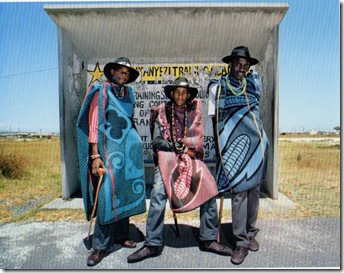
basotho

A New Beginning by Araminta de Clermont, Cape Town, South Africa, 2009-10. South Sotho men – “These three young men wear another kind of blanket known as lekhokolo, which shows that they have completed the initiation ceremony and reached manhood. Designs such as the maize cob or Poone, seen here on their Seana Marena label blankets, are very popular for lekhokolo, as they signify virility and fertility.” page 228.

Although some fine and historically significant objects from the British Museum’s collection of West African textiles are illustrated and discussed, I would have liked to see a book with this title pay more attention to developments today in the still vibrant historical textile traditions of West Africa, where significant innovation is apparent in both weaving and dyeing of cloth in many areas. Nevertheless it is African printed textiles that have in recent years been at the heart of a growing appreciation of African fashion and of a growing recognition of the work of African fashion designers. In exploring the British Museum’s expanded collection activities in this field, and in concluding with the work of Duro Olowu, a leading Nigerian born fashion designer, Spring’s lively book looks ahead to new directions in this fascinating and still under- researched field.


Monday, 20 August 2012

An exceptional Dogon uldebe blanket

FR517

Superb early example of a style of nine strip blanket with nine rows of pattern that is called Uldebe among the Dogon, where it has an important and very specific role in the funerary and post funeral rites of high status men and women. According to Bernhard Gardi (Dogon, ed. Helene Leloup, 2011, page 180) each family would have one uldebe blanket that was used to wrap the body of any important deceased man or woman during funeral ceremonies, but then, rather than being buried with the corpse as was typical of funerary cloths in West Africa, retrieved and displayed in the courtyard of the deceased for six days as a focal point for homage to the dead. A very specific variant of the blue and white cotton blankets that were used throughout much of Mali, uldebe (also known as gamba) were woven only in a few villages in the district of Pinia. A Uldebe blanket was the sole textile included in the recent Dogon exhibition in the Musee Quai Branly, Paris.

FR517d

However this particular cloth was collected in a remote village in northern Ghana where Malian blue and white blankets have been prized in Ghana for centuries and were used for prestige display be chiefs (and therefore would not have been used at funerals !) This is an exceptionally fine and early example, circa 1920-40s, woven from hand spun thread throughout, and in excellent condition. More ordinary uldebe blankets are fairly easy to obtain and indeed still in use in Mali, but an intact example of this age, quality, and condition is very rare. Click here to see this cloth and others in our online gallery.

313285_190400007701425_925494034_n[3]

Modern uldebe used to receive tribute offerings at the installation of a hogon or medicinal specialist. Photo by Inogo Dolo, 2012. More details here

fulbe

Rare image of a Fulbe elder (not Dogon) wearing an uldebe cloth as a prestige wrapper, early C20th. (vintage postcard, published by Larger, author’s collection.)