Thursday, 27 May 2010

Fante Asafo Flags at Christie’s Paris, June 15th.

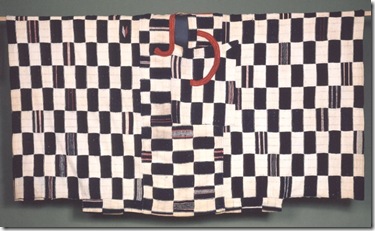
d5328017l LOT 60, SALE 5599, PARIS
Estimate: €4,000 - €6,000
($4,922 - $7,383)
d5328018l LOT 61, SALE 5599, PARIS
Estimate:€4,000 - €6,000
($4,922 - $7,383)
d5328019l LOT 62, SALE 5599, PARIS
Estimate: €4,000 - €6,000
($4,922 - $7,383)

Featuring these three flags from a major European collection, this sale will be an important test of interest in Asafo flags at a major auction house after the new and dramatically higher prices they realised at Sotheby’s in the McAlpine Collection auctions in 2006 and 2007.

Friday, 14 May 2010

Weaving Dreams: Tracing Cotton and Fashion in Africa

An interesting video by Amanda Martinez traces links between African fashion designers, the struggles of the Malian cotton industry and excessive US subsidies to American cotton growers.

Featured in the video is the remarkable Malian designer and activist Awa Meite much of whose work involves exploring the design possibilities of local cotton and Mali’s ancient textile traditions. Awa’a website is here .

Wednesday, 5 May 2010

Legacy in Cloth: Batak Textiles

legacy_in_cloth2w_754

This massive and wonderful book on the weaving of the Batak peoples of Sumatra sets a new standard for the documentation of the textile heritage of an indigenous tradition. Combining two decades of fieldwork with detailed study of museum collections and archive photographs Sandra Niessen has produced an exhaustive and definitive study which repays both casual browsing and careful study. For scholars of African textile traditions it lays down a challenge in terms of depth and detail of documentation and illustration that is both inspiring and daunting. For more details, a pdf of a sample chapter, and a way to purchase a copy direct from Sandra visit her website here

Monday, 12 April 2010

Some updates on our website today

Click pictures for description and larger view.

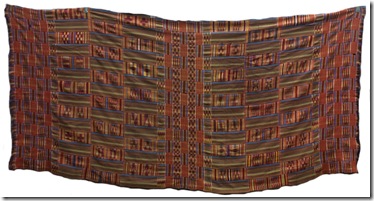
Rare Asante silk kente

kente206

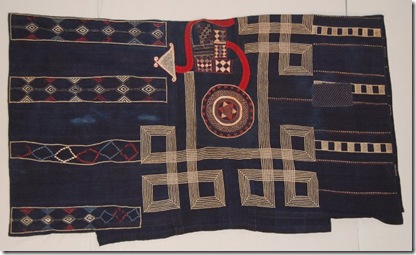
Rare Dioula cloth from Ivory Coast

fr425

Baule woman’s cloth from Ivory Coast

fr430

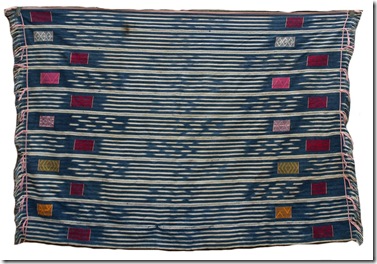
Senufo blanket from Ivory Coast

fr427

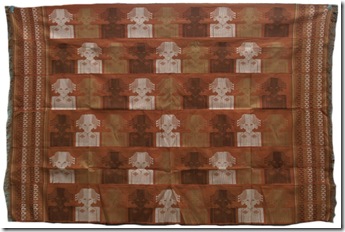
Manjak woman’s cloth, Senegal

fr431

Kpalime Ewe cloth, Togo

fr422

Sunday, 11 April 2010

Long Live the President ! – African printed cloths exhibition in Amsterdam now.

pagne25

Long Live the President ! Portrait Cloths from Africa” now at the Tropenmuseum, Amsterdam (2 April – 29 August 2010). The exhibition, curated by Paul Faber, features over 100 African printed fabrics devoted mainly to commemorating African presidents, both the well known such as Mandela and Mobutu and the now perhaps justly obscure. The show includes East African kanga as well as printed pagne from West and Central Africa. It is accompanied by a catalogue in English (details here) that is the first substantive publication devoted to this important aspect of African textile design.

I am pleased to note that a large part of the show is drawn from the French private collection we featured on our website here back in 2005. Follow the link for more images and background information on African commemorative prints. Thanks to Bernard Collet, the collector of these pieces, for the images of the exhibition shown below. Click any photo for a larger view.

DSC_1817raw

DSC_1825raw

DSC_1833raw

DSC_1864raw

Curator Paul Faber discusses the exhibition (in Dutch)

Monday, 29 March 2010

African Textiles Sale

sale010

We are having a sale of old stock, with cloths from Nigeria, Ghana, Senegal, Ivory Coast, Burkina Faso etc. All pieces are priced at GBP50, US$85, or Euro 60 plus shipping. 10% additional discount if you buy 2 or more pieces from this group. Images are online here: Sale Gallery

Friday, 12 March 2010

West African Robes in the British Museum collection

AN00318636_001_l

This rare Liberian robe acquired by the British Museum from Henry Christy in the 1860s (click on the photo for more details) is one highlight among many of what must surely be the world’s most comprehensive and important collection of West African robes. Already numbering several hundred items it was recently augmented by the purchase of the Heathcote collection from David Heathcote, the scholar of Hausa embroidery (search the database using his name in the “Provenance” field to bring up 390 items in this collection, including robes, hats, trousers, embroidery samples etc. ) Derived from north African prototypes these robes are historically linked to the spread of Islam throughout much of West Africa in the course of the 2nd millennium C.E. Together with the related crafts of embroidery and narrow strip loom weaving their distribution closely followed patterns of long distance trade that were dominated by Muslim members of such peoples as the Mande and Hausa. (The relationship between narrow strip weaving and Islam in West Africa is a complex one that I may address in a later post.) Called boubou in Francophone literature and tobe in early Anglophone travellers’ reports, these elaborate man’s gowns were much admired by European visitors to the region and many early examples have found their way to the British Museum.
AN00507003_001_l

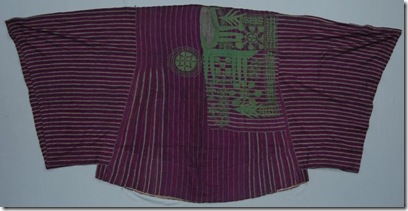
The best known regional style of robe tailoring and embroidery was the embroidered “riga” associated with the C19th Sokoto Caliphate in northern Nigeria although it had, and in modern versions still has, a much wider distribution as an important style of male prestige dress across a large area of West Africa. The example shown above was woven from magenta dyed waste silk (alharini in Hausa, alaari in Yoruba) from the trans-Saharan trade and was part of the late C19th Beving collection. It retains an early label reading: 'Gown made from strips woven on a narrow loom with European waste silk yarns. Embroidered round neck with green European thread. Lined throughout with strips of native woven cloth of indigo and white yarns and around the hem with native woven cloths of grey waste silk yarns.' Throughout the Hausa, Nupe and Yoruba regions of Nigeria magenta silk formed a key component of a triumvirate of prestige fabrics along with beige local wild silk (Hausa tsamiya, Yoruba sanyan) and a fine indigo dyed check or plaid (Hausa saki, Yoruba etu.) Among the many early examples in the British Museum collection the three saki robes below show increasing degrees of elaboration in the classic Nigerian embroidery design known as “eight knives” (Hausa aska takwas.) [click on photos to go to the object records.]

AN00569540_001_l

AN00740592_001_l

AN00517214_001_l

The British Museum collection is also rich in more rare robe styles, several examples of which we show below.

Boubou tilbi, Djenne region, Mali

AN00742490_001_l

Boubou lomasa, Soninke people, Mali

AN00591368_001_l

Boubou Manding, Liberia/Sierra Leone

AN00412413_001_l

AN00535202_001_l

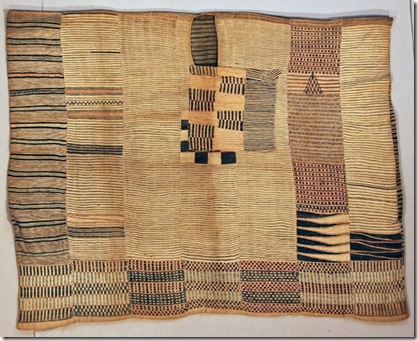
Sierra Leone, Mende or Sherbro people
AN00412685_001_l

For more information on West African robes consult the following sources:

Gardi,B. Le Boubou - c'est chic. (2002) – a superb and beautiful book.

Gardi,B. "La broderie" in Bedaux, R. & van der Waals, J. eds Djenné: une ville millénaire au Mali (1994)

Heathcote, D. "Aspects of Embroidery in Nigeria" in Picton,J. ed. The Art of African Textiles (1995) -see bibliography for Heathcot's numerous other articles on Hausa embroidery.

Perani,J. "The Cloth Connection: Patrons and Producers of Hausa and Nupe Prestige Strip-Weave"in History, Design, and Craft in West African Strip-Woven Cloth (1992)

Perani,J. & Wolff,N. "Embroidered Gowns and Equestrian Ensembles of the Kano Aristocracy." in African Arts 25(3) (1992)

Prussin, L. Hatumere: Islamic Design in West Africa (1986) Chapter 8

Worden, S. "Prestige Robes of the Hausa-Fulani in Liverpool Museum" in Text 30 (2002)

To see our some of our current stock, which primarily consists of early Nigerian robes, click here.